
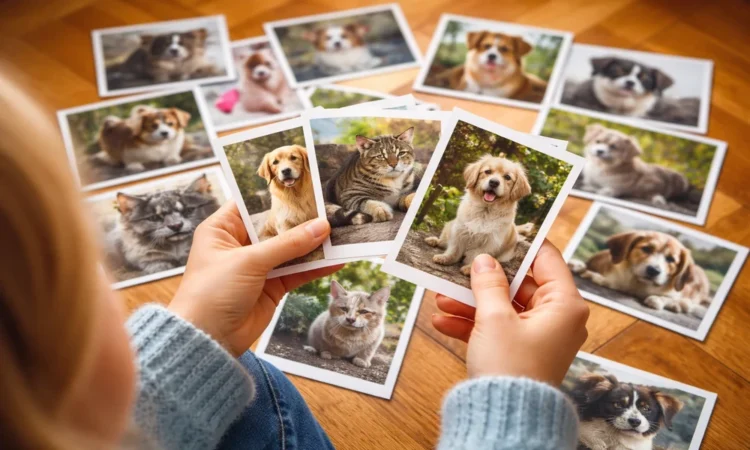
A gallery of pet portraits can be easy to love and surprisingly difficult to evaluate. You might save a striking image because of its colors, its setting, or the animal in it. None of those reactions tells you exactly what a maker could do with your own photograph.
Before placing an order, turn a few favorites into a small set of useful evidence. Look at what each example shows, what remains unclear, and which questions matter for your pet. You do not need to become an art critic. You need a way to connect the pictures you admire with the result you hope to receive.
Start with examples you can actually compare
Choose three or four examples that interest you for different reasons. One might have a familiar expression, another an appealing treatment of markings, and a third a presentation you could imagine at home. Keep a note explaining why you saved each one.
Where available, put the source photograph beside the finished artwork. Compare those two images before comparing one seller with another. A finished picture alone can show that you like a style; a photograph paired with it gives you something more specific to examine.
Notice what the example represents. Is it an artwork preview, a photograph of a physical product, or an image showing the design in a room? These answer different questions. A room image may help you imagine a display without showing the surface closely. An artwork preview may reveal details without establishing how an external frame looks.
If the presentation does not make that distinction clear, write “unknown” beside it. Avoid assuming that every display image documents a customer order. You can appreciate an example while still asking what kind of example it is.
Keep the comparison manageable. A folder of fifty images is less useful than a short list with reasons attached.
Try giving each saved example one job. The first can answer a question about expression, the second about a particular pattern, and the third about physical presentation. If an image adds nothing you cannot already see elsewhere, set it aside. This leaves you with a reference set you can explain in a few sentences, instead of a collection of favorites whose relevance is difficult to remember.
Look for the information that survived the transformation
For each paired example, identify two or three features in the photograph and locate them in the artwork. Choose observable details rather than a vague impression of quality. You might follow the boundary of a dark cheek patch, the shape of a raised ear, or the angle of the head.
Then ask what changed intentionally. Perhaps the background became simpler, the color treatment became softer, or the portrait placed the pet in a fictional setting. Separate those choices from changes you would not want in your own picture.
Imagine, for example, that your pet has a small pale marking beside one eye. You might welcome an imaginative background while wanting that marking to remain distinct. Another owner might prefer a simplified interpretation. The useful question is whether the example demonstrates the kind of attention you value.
Be equally careful about what you cannot see. A tiny gallery image may leave a feature unclear. That is a reason to request a closer example, rather than to decide that the feature was definitely omitted.
Visual texture is also different from a description of production. If the distinction between an original drawing, a digital artwork, and a physical print matters to you, read the product information. Do not settle that question from a painterly appearance alone.
Find a relevant challenge, not an identical pet
An exact match for your pet may not exist in a gallery. Instead, look for a visual question similar to yours.
If your photograph shows dark markings against dark fur, examine examples where those areas need to remain distinguishable. If your pet has a distinctive side profile, seek examples with a comparable viewing angle. If the feature you care about sits below the face, look at how much of the body the offered composition includes.
This approach works beyond dog portraits and cat portraits. The relevant comparison for a bird might be the outline of its crest; for another animal, it might be a familiar posture. You are looking for evidence that relates to the picture you want, without assuming that one successful example proves every possible layout will work.
Write down the strongest match and the largest gap. For instance: “I like how these examples keep uneven markings visible, but I have not seen this design used with a long, narrow face.” That gives the maker a concrete question to answer.
The absence of a close example does not establish a lack of ability. It means that part of your decision still needs a conversation.
Connect the gallery to the actual order
Once the artwork interests you, check the specific offer behind it. Which design are you considering? What physical format is included? Which options are shown for that product? A gallery may contain several approaches, and an option on one listing may not apply to another.
For example, you can browse Pawfolio Art to compare its current custom pet portraits, then identify the particular design and product you would want to discuss. Keep the listing with your saved example so your questions refer to something definite.
Next, read the steps between submitting a photograph and receiving the finished item. Look for an explanation of how reference images are supplied, whether artwork is reviewed before production, and how the maker handles questions. Ask about any term you would otherwise have to interpret yourself.
Pawfolio’s explanation of how the portrait process works is useful at this stage because it distinguishes the artwork-review process from the product selection. Read the applicable details for the item you are considering rather than extending one process to everything a shop sells.
This is still a pre-order decision. You are checking whether the process gives you the information you need, not trying to conduct a finished-artwork review before any artwork exists.
Build a shortlist with questions attached
Use a three-column note: “What I can see,” “What I still need to know,” and “Why it matters to my order.” Fill it with observations specific enough that another person could understand them.
Here is an illustrative entry:
- What I can see: The example keeps the pale chest marking visible while simplifying the background.
- What I still need to know: Can the selected layout include my pet’s chest rather than only the head?
- Why it matters: That marking is one of the details I want to recognize immediately.
Make another entry for the physical product if necessary. An attractive artwork preview does not answer a question about the finished frame, and a room photograph does not answer every question about the artwork.
Avoid assigning a numerical score to things you cannot verify. “Unknown” is more useful than a confident rating based on an assumption. If two providers remain on your list, send each the same essential question and compare how directly their answers address it.
You may discover that your favorite gallery image represents a different product from the one you planned to buy. That is useful information to uncover before ordering.
Make the next step specific
Before commissioning pet portraits from photos, choose the unanswered question most likely to change your decision. Send the relevant photograph, identify the design, and explain the feature you want to preserve.
A portfolio has done its job when it helps you make an informed choice, including recognizing when you need more information. Keep the examples that explain your preference, set aside the ones that merely caught your eye, and order when the artwork and the actual offer make sense together.